


Transforming Automatic Number Plate Recognition Analytics with Governed Agentic AI
Executive Summary
Volty IoT Solutions operates Automatic Number Plate Recognition (ANPR) systems that generate continuous, high-volume operational and time-series data. Business users needed secure, real-time insights that didn’t depend on SQL expertise or manual data workflows.
Fission Labs partnered with Volty to build a governed, multi-agent AI analytics platform on AWS that enables natural-language interaction with analytics while enforcing strict governance, performance isolation, and auditability. The implemented solution combines structured agent orchestration with AWS managed services to deliver deterministic execution, conversational intelligence, and enterprise-grade compliance.
Business Challenge
The ANPR analytics ecosystem at Volty was constrained by several critical challenges:
- Limited Self-Serve Analytics: Business users were dependent on SQL specialists for insights, slowing decision cycles and increasing operational bottlenecks.
- Complex Reasoning Requirements: ANPR analytics often require multi-step reasoning, such as comparative analysis across temporal windows, joins across sources, schema validation, and iterative exploration — which traditional BI tools couldn’t support.
- Governance and Risk Exposure: Early attempts to introduce LLM-driven query generation presented risks of hallucinated queries, unauthorized access, and unpredictable load on PostgreSQL systems. Without governance or audit trails, these approaches were unsuitable for enterprise use.
The combined effect was slow insight generation, constrained user autonomy, and elevated governance risks.
Technical Solution
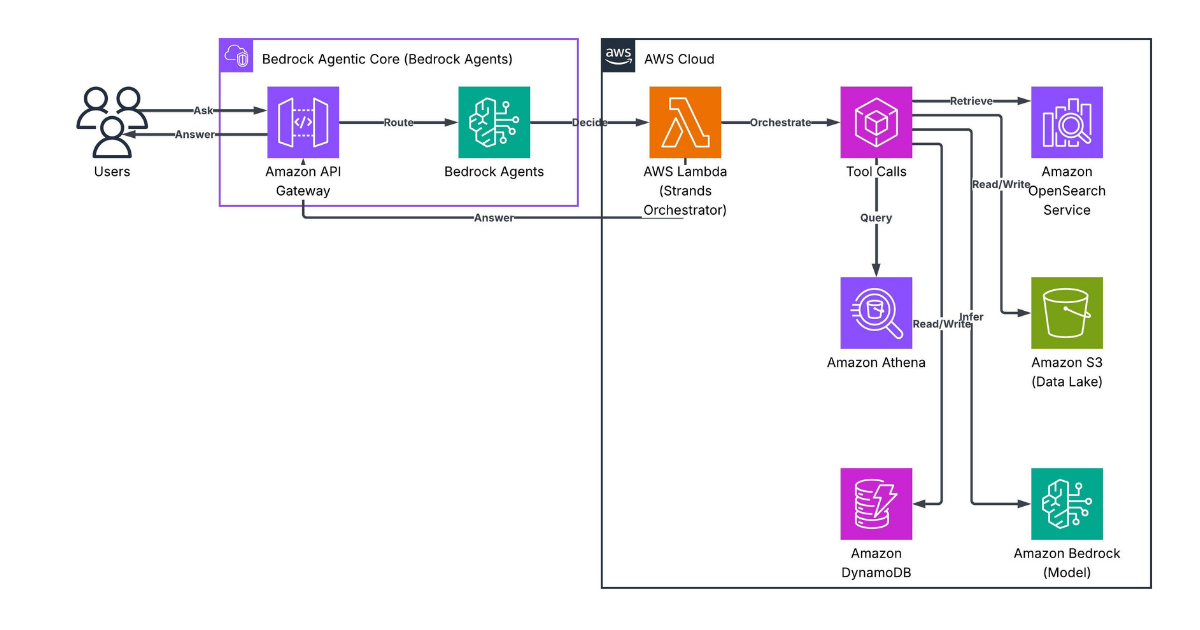
Fission Labs designed and implemented a multi-agent, governed, Agentic AI analytics platform on AWS that separates reasoning, execution, and governance logic.
Structured Agent Orchestration
The solution uses the Strands Framework orchestrated via Amazon Bedrock Agentic Core to manage agent roles with defined responsibilities:
- Planner Agent determines intent and orchestrates logical steps.
- Data Agent validates schema, enforces governance, and extracts filters.
- Athena Agent constructs deterministic, optimized queries against curated datasets — preventing uncontrolled LLM SQL execution.
- Vector Agent handles semantic retrieval when needed.
- Answer Agent generates grounded, contextually accurate responses.
This architecture ensures deterministic execution with auditability and governance at every step.
Operational and Analytical Separation
Operational ANPR data remains in PostgreSQL to protect transactional performance. A streaming layer (powered by Olake) continuously ingests structured, timestamped records into Amazon S3. Analytical workloads execute on curated Amazon S3 datasets through Amazon Athena, ensuring query performance without impacting production systems.
Conversational Intelligence with Context
Session state and short-term conversational memory are managed to support multi-turn interactions such as:
- “Show checkpoint activity for last week”
- “Compare that with the previous month”
- “Break down night-hour activity by checkpoint”
Semantic context is maintained and retrieved via vector indexes, enabling natural-language analytics that remain governed and deterministic.
Key AWS Services Used
The implementation integrated AWS managed services to balance performance, scalability, and governance:
- Amazon Bedrock – Foundation model access and agent inference execution
- Amazon Bedrock Agentic Core – Managed agent runtime for structured orchestration
- AWS Lambda – Serverless compute for agent orchestration and tool execution
- Amazon API Gateway – Secure API frontend with access control
- Amazon S3 – Curated data lake for analytical workloads
- Amazon Athena – Deterministic SQL execution against S3 datasets
- Amazon OpenSearch Service – Vector search for semantic retrieval
- Amazon DynamoDB – Session state and conversational memory store
- AWS Identity and Access Management (IAM) – Role-based access and governance
- Amazon CloudWatch – Monitoring, logs, and audit trails
These services enabled a secure, scalable, and governed analytics platform capable of natural-language interaction.
Project Outcome and Impact
Fission Labs’ solution delivered measurable outcomes across operations, performance, governance, and business enablement:
- Operational Efficiency: Significantly reduced manual reporting effort and reliance on SQL specialists.
- Performance and Scalability: Achieved sub-second to low-second query latency with fully serverless auto-scaling infrastructure.
- Governance and Compliance: Eliminated uncontrolled LLM SQL execution while maintaining audit trails and access controls.
- Business Enablement: Equipped non-technical users with conversational analytics and accelerated trend detection.
By separating analytical workloads from operational systems and anchoring execution in deterministic governance, the platform provides a robust foundation for future predictive and autonomous AI capabilities.
The true value of this platform lies in its seamless integration with existing traffic and enforcement ecosystems. By decoupling analytics from core operations and embedding governed conversational intelligence, we can rapidly deploy secure, scalable solutions across multiple government programs and geographies without disrupting mission critical systems. — Konark, CEO, Volty IoT Solutions
Conclusion
This implementation demonstrates how enterprise analytics — even at high velocity and scale — can be made accessible through governed AI without compromising performance or compliance. The architecture provides a scalable blueprint for applying agentic AI to operational data in regulated and mission-critical environments.
For organizations exploring how conversational intelligence and governed analytics can accelerate decision making and operational insight, Fission Labs offers tailored AI and cloud engineering solutions aligned to enterprise needs.