


This article makes a single argument: AI projects do not fail on the model. They fail on six production dimensions that nobody checks before the budget is committed, and every one of them is checkable in advance.
The industry numbers describe the outcome. Gartner projects 60% of AI projects will be abandoned through 2026. Forbes reports fewer than 30% of CEOs are satisfied with AI investment returns. But those numbers get misread as a technology problem, and that misreading is exactly why the pattern keeps repeating.
The technology works. Your POC proved that. What your POC did not prove is that the system can serve real users, honor enterprise permissions, meet latency targets, withstand prompt attacks, and justify its cost profile at scale. That is a different engineering problem, and it is the one budgets actually die on.
Why do AI projects really fail?
The failures are not technical mysteries. They follow a predictable pattern: the initiatives that stall trace back to some combination of six dimensions teams consistently underestimate. Accuracy, safety, evaluation, access control, scale, and tokenomics.
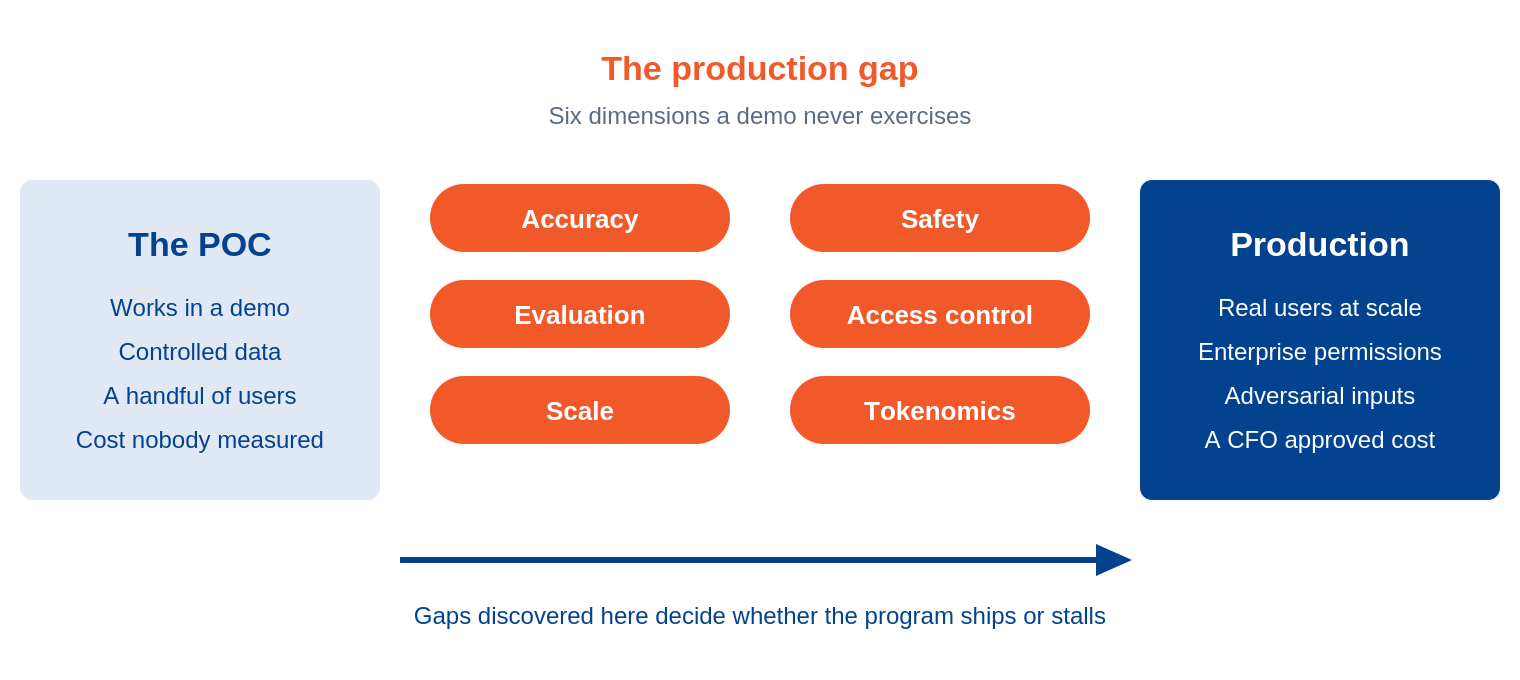
What makes these six dangerous is not that they are hard. Individually, each is a solved engineering problem. What makes them dangerous is when they get discovered. A demo exercises none of them, so teams find the gaps after leadership has committed a budget, which converts an engineering task into a credibility crisis. By the time the CISO blocks rollout or the first month's inference bill lands, the program is defending itself instead of shipping.
The teams that make it to production are not smarter. They pressure test all six dimensions before rollout, the same way they would review architecture before a platform migration. At Fission Labs we codified that pressure test into a 15 checkpoint instrument designed to run in a single leadership review, and the rest of this article shows you how the method works on one of those checkpoints, so you can judge whether it is worth running on all 15.
The method, demonstrated on one checkpoint: token economics
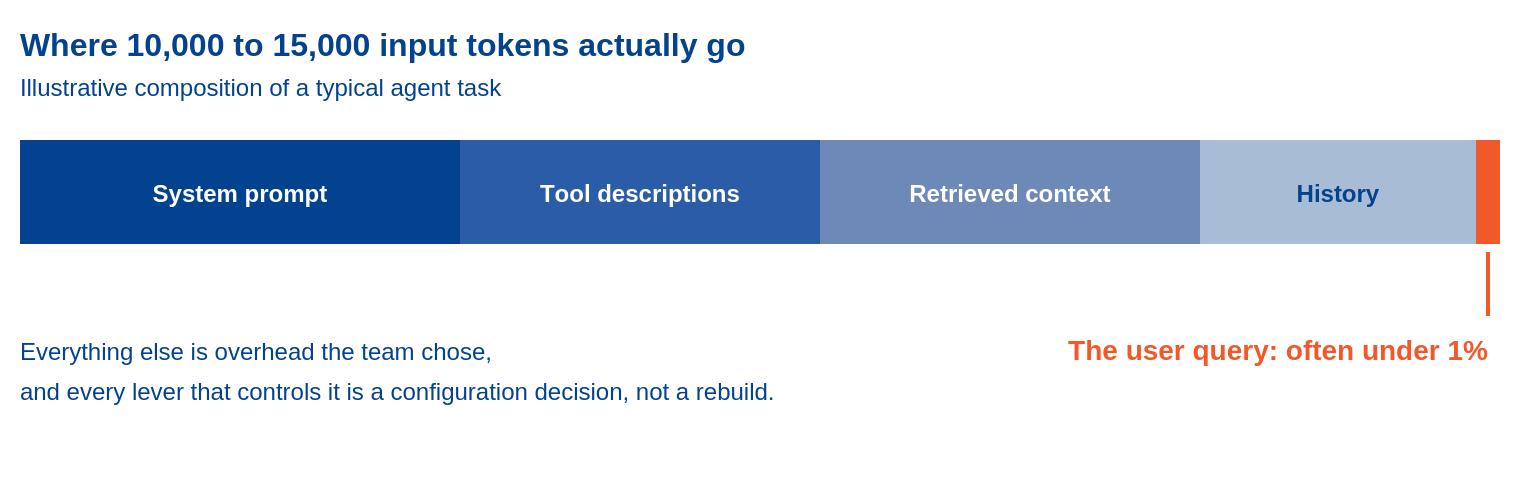
Ask your engineering lead a simple question: on a typical agent task, what percentage of input tokens is the actual user query?
Most teams cannot answer it. The teams that measure it are usually shocked. A typical agent task burns 10,000 to 15,000 input tokens, and the user query is often under 1% of that. The other 99% is system prompts, tool descriptions, retrieved context, conversation history, and tool outputs. Overhead the team chose, mostly without noticing they were choosing it.
Now the checkpoint structure. Each of the 15 follows the same shape:
The uncomfortable truth: if you cannot predict unit economics at a million tasks per month, you do not have a production system. You have a bill waiting to surprise you.
The decision to make: are token budgets measured by component in production, or estimated once during prototyping and never again?
The questions to ask your team: where do the tokens actually go by component, and what are the before and after numbers on the four levers that control them?
Notice what this does in a leadership review. It converts a vague anxiety ("are our AI costs under control?") into a binary question with evidence attached. Either the team can produce the breakdown or it cannot. Either answer is useful: one confirms readiness, and the other hands you a defined work item in place of an open ended worry.
That conversion, from anxiety to evidence, is what the checklist does 15 times across cost, reliability, and governance. It is also why the reviews work: nobody has to win an argument; they just have to produce the numbers.
The three conversations the checklist prepares you for
The 15 checkpoints are organized into three themes because they map to three separate conversations, each with a different stakeholder who can kill the program.
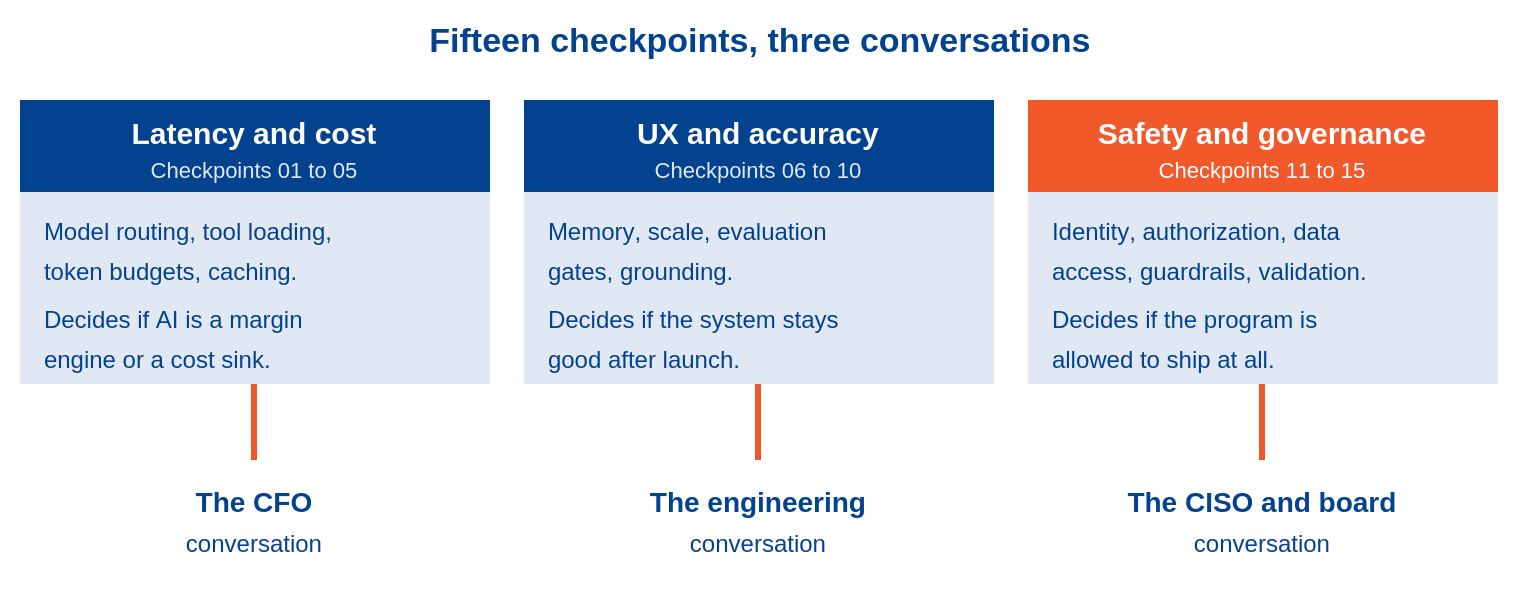
The CFO conversation is about unit economics: model routing, tool loading, caching, and the token discipline above. These decide whether AI becomes a margin engine or a cost sink, and they are the highest leverage fixes because most are configuration decisions, not rebuilds.
The CISO conversation is the one most programs are least prepared for, and it is where projects get blocked before they leave the lab. Identity, authorization, data access, guardrails, and validation each need a separate control, and the failure modes are not hypothetical. When an agent executes with a broad service account instead of the end user's identity, every user inherits the agent's data access. That is not an AI quirk. That is a breach pattern, and your security team will find it in the first architecture review, so you want to find it first.
The engineering conversation covers whether the system stays good: memory governance, evaluation gates, monitoring for silent regression, and grounding responses in your actual systems of record rather than model pretraining. An agent that quietly degrades after a model update is not a product, it is a prototype on borrowed time.
If you can walk into all three conversations with evidence instead of assurances, you are ahead of the majority of AI programs in flight right now.
What to do this week
Do not commission a readiness workstream. Run a review.
Get the checklist and read it straight through once, which takes roughly 25 minutes. Then put it in front of your engineering and platform leads and score all 15 checkpoints honestly: ready, partial, or gap. The gaps become your production roadmap, sequenced and evidenced, before anyone outside the room discovers them for you.
Because the alternative is the default path: the gaps surface anyway, one incident, one blocked review, one surprise invoice at a time, on a schedule you do not control.