



By Fission Labs | June 2026 | 5 min read
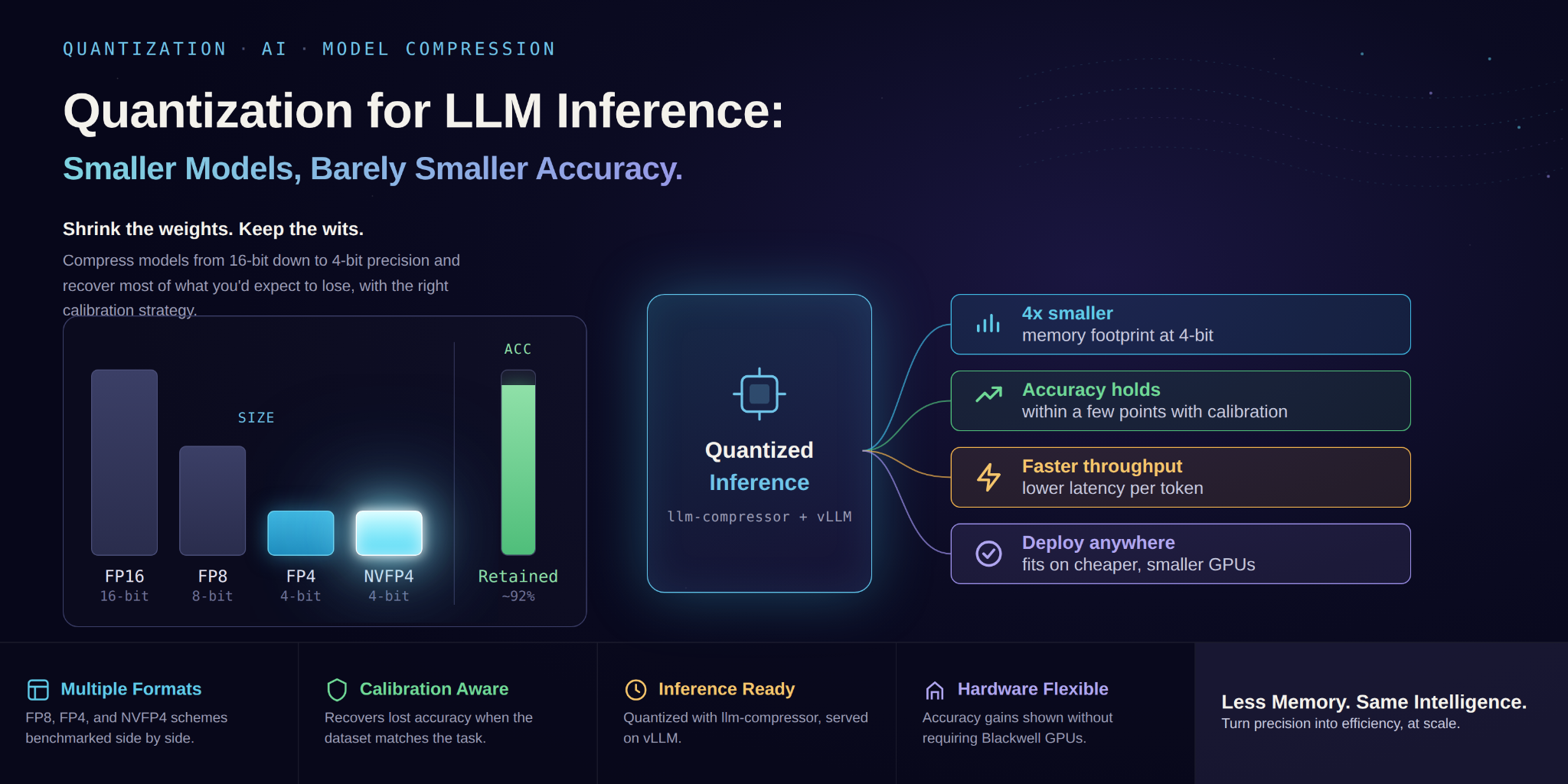
Large language models are expensive to run. An 8 billion parameter model, in case of Llama 3.1 8B Instruct needs around 16 GB of memory just to hold its weights in BF16, before you even account for activations, KV cache, and batching overhead. Scale that to multiple GPUs serving thousands of requests, and memory and compute costs start to dominate the conversation. This is the core problem quantization tries to solve, shrinking the model's footprint so it fits on cheaper hardware and runs faster, without throwing away what makes it useful in the first place.
The catch is that quantization is rarely free. Reducing precision from 16 bits down to 8 or 4 bits per weight means the model is working with a coarser approximation of the numbers it learned during training. Practitioners are right to be cautious here. A model that gets noticeably worse at reasoning or factual recall is not a good trade no matter how much memory it saves.
So the real question is not whether quantization causes accuracy loss. It almost always does, at least a little. The real question is how much, and whether that loss can be reduced. To find out, we quantized Llama 3.1 8B Instruct into several different formats and measured how each one performed on two fairly different benchmarks, then dug into whether a calibration step could close the gap.
What Quantization Actually Does
At a high level, quantization maps a model's weights and activations from a high precision format, like 16 bit floating point, into a lower precision format, like 8 bit or 4 bit representations. Fewer bits per number means less memory to store the model and, on the right hardware, faster computation, since moving and multiplying smaller numbers is cheaper than moving and multiplying larger ones.
The trade off comes from the fact that fewer bits mean less room to represent the original range and precision of values. Weights that were once distinct floating point numbers can get rounded into the same low precision bucket. This rounding error is usually small for any individual weight, but it accumulates across millions of computations, layer after layer, and the cumulative effect can show up as a measurable drop in the model's output quality. This is a well documented effect, post training quantization in general tends to introduce some accuracy degradation, with the exact amount depending heavily on the format used and how aggressively precision is reduced.
This raises a natural follow up question. If quantization is going to hurt accuracy a bit, is there a way to recover some of that loss without paying the full cost of retraining the model?
Calibration
This is where calibration comes in. Calibration is a post training step where you run a small batch of representative data through the model after quantization, and use the resulting activation statistics to tune the quantization parameters, things like scaling factors and clipping ranges, more carefully. Crucially, calibration does not update the model's weights through gradient descent. It simply helps the quantization process pick better numerical ranges based on how the model actually behaves on real inputs, rather than relying on generic assumptions.
Calibration Vs Fine-Tuning
Fine-tuning, specifically quantization aware fine-tuning, takes a more involved approach. Here the model is actually retrained, sometimes with the quantization operation built into the training loop, so the weights themselves adjust to compensate for the precision loss. This generally recovers more accuracy than calibration alone, since the model gets to relearn around its new constraints. But it comes at a real cost. Fine-tuning needs labeled or representative training data at scale, GPU time for multiple training passes, and a more complex pipeline overall.
Calibration sits at a different point on that cost curve. It typically needs only a few hundred examples and a single forward pass over them, no backpropagation, no optimizer, no multi epoch training run. For teams that want to quantize a model and ship it quickly, calibration is the more practical first step, even if it does not always close the accuracy gap as completely as fine-tuning would.
Experiment Setup
We evaluated Llama 3.1 8B Instruct, loaded with vLLM and quantized using llm-compressor, across five configurations, the original FP16 weights as a reference point, FP8 as a baseline, FP4, a calibrated version of FP4, and calibrated NVFP4. The FP16 numbers here are worth a quick clarification, the underlying weights are BF16, but we ran inference using float16 arithmetic instead of bfloat16. We did test running the same setup with native bfloat16 computation and saw no meaningful difference in the results, so we treat the FP16 numbers as representative of the original, unquantized model's behavior.
NVFP4 is NVIDIA's 4 bit floating point format, built around a dual level scaling scheme that uses small micro-blocks of 16 values with their own FP8 scale, plus a global FP32 scale across the full tensor. It is designed to preserve more accuracy at 4 bit precision than older formats by giving the quantizer more flexibility in how it represents the original distribution of weights. We quantized using llm-compressor's NVFP4 scheme, which quantizes both weights and activations together. Since this scheme requires a calibration dataset to compute those activation statistics in the first place, every NVFP4 result we report is inherently calibrated, there is no uncalibrated NVFP4 variant to compare against. We also did not have access to Blackwell hardware, which is where NVFP4 gets its strongest software and tensor core support, so our setup reflects the accuracy NVFP4 produces on more widely available hardware, not its full performance profile.
For evaluation, we used two benchmarks that test fairly different capabilities, MMLU-Pro, a broad multiple choice benchmark covering knowledge and reasoning across many subjects, and MATH-500, a set of math problems that require working through a problem to a normalized final answer rather than picking from options. For MMLU-Pro, correctness was determined by exact match against the correct option letter. For MATH-500, we normalized the model's final answer and the ground truth answer before checking equality, which avoids penalizing the model for harmless formatting differences while still requiring it to get the actual answer right.
Results: Quantized Models vs the Original
The table below summarizes accuracy across all five configurations on both benchmarks.
The first thing that stands out is that the size of the accuracy drop depends heavily on both the format and the benchmark. On MMLU-Pro, uncalibrated FP4 lost 10.5 percentage points relative to FP8, the largest drop we observed anywhere in this experiment. FP8 itself stayed close to the FP16 reference, actually landing slightly above it on MMLU-Pro, which is consistent with FP8 being a relatively gentle reduction in precision compared to 4 bit formats. NVFP4 fell in between, down 2.5 points from FP8 on MMLU-Pro, noticeably better than plain FP4 despite also being a 4 bit format.
MATH-500 told a different story. Here, FP4's uncalibrated drop relative to FP8 was a more modest 2.0 points, smaller than what we saw on MMLU-Pro. NVFP4 fell by 6.5 points on this benchmark, larger than its MMLU-Pro drop and larger than plain FP4's drop on the same benchmark. The ranking of formats was not consistent across benchmarks, a format that held up well on one task did not necessarily hold up as well on the other.
This is the first useful takeaway on its own. Accuracy degradation from quantization is not a single number you can quote for a given format. It depends on what kind of task you are measuring, and a format that looks safe on one benchmark might show a larger drop on another. The memory savings from moving to FP4 or NVFP4 are substantial regardless, since both pack weights into roughly a quarter of the bits FP16 uses, but the accuracy side of that trade off needs to be checked against the kind of workload the model will actually serve.
Calibration Analysis
The more interesting part of this experiment is what happened when we added calibration. We calibrated two formats, FP4 and NVFP4, using HuggingFaceH4/ultrachat_200k, a conversational instruction following the dataset, as the calibration data. NVFP4 was calibrated by necessity, since its quantization scheme requires activation statistics to even produce a model. FP4 gave us a cleaner before and after comparison, since we had both an uncalibrated and a calibrated version to look at side by side.
On MMLU-Pro, calibration helped FP4 substantially. Accuracy went from 40.0% uncalibrated to 45.5% calibrated, cutting the gap to FP8 roughly in half, from a 10.5 point drop down to 5.0 points. This is a meaningful recovery from a relatively cheap step, no retraining, just a better calibrated set of quantization parameters.
On MATH-500, the picture flipped. Calibrated FP4 actually performed worse than uncalibrated FP4, dropping from 36.5% to 32.0%, a larger gap relative to FP8 after calibration than before it.
Why would calibration help on one benchmark and hurt on the other, using the exact same calibration dataset and the exact same quantized model otherwise? The most plausible explanation traces back to what the calibration data actually looks like. ultrachat_200k is built from multi-turn conversational exchanges, the kind of open-ended, instruction-following dialogue that closely resembles how MMLU-Pro questions are framed, a question followed by a direct request for an answer. Calibrating on data that looks like the evaluation task gives the quantizer a more accurate picture of the activation ranges it will actually see at inference time, which is likely why MMLU-Pro benefited so clearly.
MATH-500 is a different kind of task. It requires multi step numerical and symbolic reasoning, often with chains of intermediate calculation before arriving at a final answer. Conversational chat data does not really exercise that kind of reasoning pattern. If the activation statistics calibration relies on were shaped by chat style inputs that do not stress the same internal pathways math problems do, the resulting scaling factors may end up tuned for the wrong distribution when the model is actually solving a math problem. That mismatch is a reasonable explanation for why calibration appeared to make FP4 worse rather than better on MATH-500, the calibration step optimized the model for a data distribution that MATH-500 simply does not resemble.
NVFP4's results are consistent with this same pattern, even without an uncalibrated comparison point. It performed comparatively well on MMLU-Pro, the benchmark more aligned with its ultrachat_200k calibration data, and worse on MATH-500, where that alignment breaks down. The dual scaling design of NVFP4 may also be doing some of the work here, giving it more headroom to absorb a calibration set that is not perfectly matched to every downstream task, but the underlying sensitivity to calibration data still shows up in the MATH-500 numbers.
Key Takeaways
A few things stood out clearly from this experiment. Quantization does introduce some accuracy degradation, that part was true across every format we tested. But the size of that degradation was generally not large, especially for FP8 and for calibrated 4 bit formats, both stayed within a few points of the FP16 reference on at least one of the two benchmarks. Calibration can recover a meaningful chunk of the accuracy lost to aggressive quantization. The FP4 to FP8 gap on MMLU-Pro shrank by half after calibration. At the same time, calibration is not a guaranteed improvement, its effectiveness depends on how well the calibration dataset represents the tasks the model will actually be evaluated or deployed on. A conversational dataset like ultrachat_200k aligned well with an instruction following benchmark like MMLU-Pro, but did not transfer that same benefit to a reasoning heavy benchmark like MATH-500. The same calibration strategy produced opposite effects depending on which benchmark you looked at, which is a useful reminder that quantization results from one task do not automatically generalize to another.
Conclusion
Taken together, these results point to a simple practical rule. Quantization is a practical default rather than a risky one for most teams, and the memory savings, roughly a 4x reduction in weight storage moving from FP16 to a 4 bit format, are large enough to be worth pursuing whenever a workload can tolerate a small accuracy trade off. Pick the quantization format based on what the workload can tolerate, and pick the calibration data based on what the workload actually looks like.
FP8 is the safer default when accuracy matters most, since it gives up very little while still cutting memory usage significantly, making it a good starting point for teams that want savings without spending time on calibration. Lower bit formats become worth considering once memory or latency constraints get tighter, but they come with a condition, the calibration dataset needs to reflect the actual deployment task rather than being a convenient or popular choice.
Picking calibration data that matches the target workload, conversational data for chat use cases, domain specific data for reasoning or specialized tasks, will do more for final accuracy than the decision to calibrate in the first place, and skipping this matching step is where calibration is likely to backfire, as it did for us on MATH-500.
The broader lesson is to treat quantization format and calibration dataset as a paired decision tied to your specific deployment rather than a one size fits all setting. Run your own evaluation on tasks that resemble your production workload before committing to a strategy, since memory savings and accuracy are both real considerations, and the right choice balances both rather than optimizing for either one alone.
References
- https://developer.nvidia.com/blog/introducing-nvfp4-for-efficient-and-accurate-low-precision-inference/
- https://arxiv.org/abs/2601.20088
- https://medium.com/data-science-collective/nvfp4-same-accuracy-with-2-3x-higher-throughput-for-4-bit-llms-03518ecba108
- https://build.nvidia.com/spark/nvfp4-quantization
- https://docs.vllm.ai/projects/llm-compressor/en/latest/examples/quantization_w4a4_fp4/