


Blog by: Ratnakar Bijili | Fission Labs | 6 min read
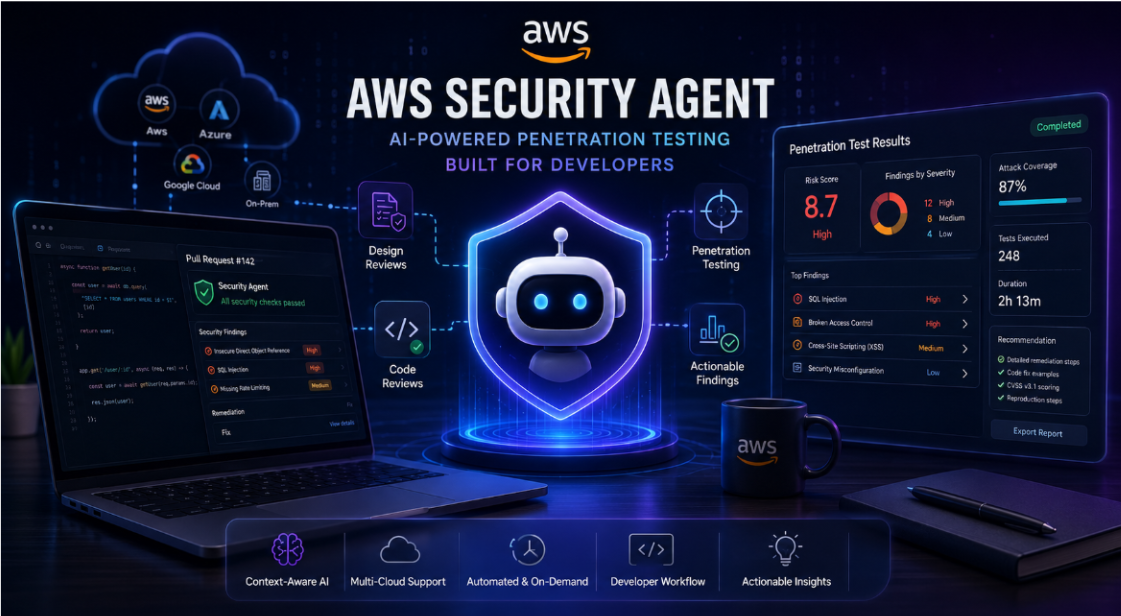
When I first came across the phrase "AI-powered penetration testing" on an AWS product page, my eyes glazed over a little. It felt like another shiny tool wrapped in buzzwords, designed more for a CISO's slide deck than for someone who actually writes and ships code.
But then I started digging into the docs. And the more I read, the more I found myself thinking: this one might actually be different.
Here's my honest take on AWS Security Agent - what it is, what genuinely impressed me, where I'm still skeptical, and whether you should bother trying it.
The Problem It's Solving (And It's a Real One)
Before we get into the product, let's talk about the reality most of us are living in.
Security testing has long been treated as something that happens after the real work is done. The feature gets built, the pull request gets opened, and only later, often at the last possible moment, does security enter the conversation. If you're at a smaller company, that "somewhere downstream" might be a quarterly pen test conducted by an external vendor who doesn't fully understand your stack. By the time findings come back, you've already built three more features on top of the vulnerable code.
According to Checkmarx's 2026 report, 75% of organizations knowingly deploy insecure code to meet delivery deadlines. And while most teams update their apps weekly or more, nearly three quarters test for vulnerabilities monthly or less. That's a massive gap between when vulnerabilities are introduced and when they're caught.
AWS Security Agent is AWS's attempt to close that gap. Not by asking developers to become security experts, but by embedding a security-aware agent directly into the development lifecycle.
What It Actually Does
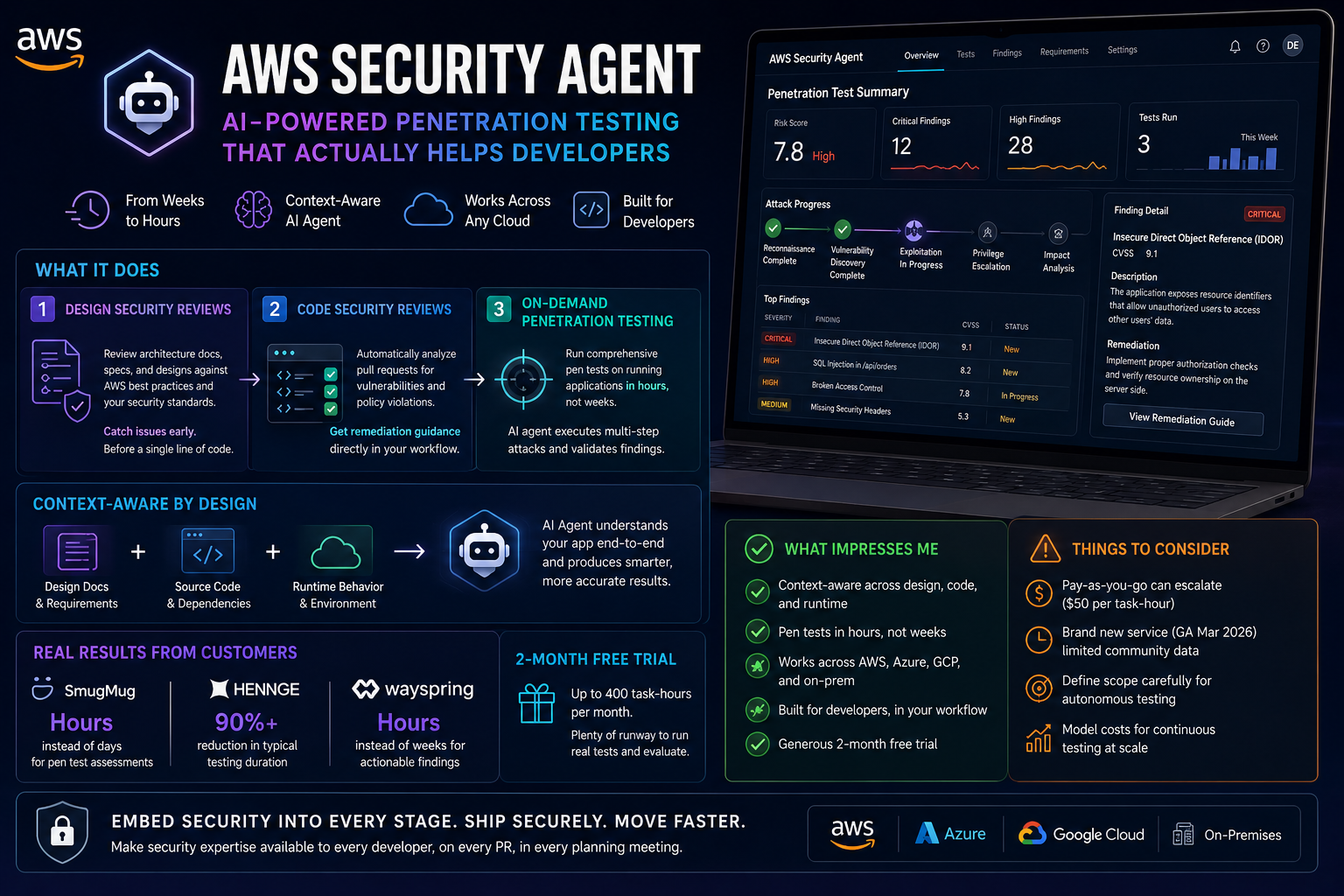
AWS Security Agent does three things, and it's worth understanding each one separately rather than lumping them together under "AI security tool."
1. Design Security Reviews
Before you write a single line of code, you can feed the agent your architecture documents, product specs, or technical designs. It will review them against AWS best practices and your organization's specific security requirements, things like approved encryption libraries, authentication frameworks, or logging standards.
The idea is to catch threat modeling issues at the planning stage, not in production. If your architecture doc says you're storing PII in a certain way that violates your own standards, the agent flags it before a developer has spent two sprints building it.
2. Code Security Reviews on Pull Requests
This is where it gets interesting for developers specifically. The agent can automatically analyze pull requests, checking code against your organizational security requirements and common vulnerability patterns. It provides remediation guidance directly in the developer's workflow, not in a separate portal or a monthly PDF.
For teams with multiple dev squads moving fast, this is potentially huge. Instead of one security engineer trying to review PRs across five teams, you have consistent standards enforced automatically on every single PR.
3. On-Demand Penetration Testing
This is the flagship capability and the one that went generally available in March 2026. Traditionally, pen testing is a scheduled event where you book a firm, wait for availability, share access credentials, wait weeks for a report, then try to action findings that may already be stale.
AWS Security Agent flips this. You can run a pen test on demand, against a running application, and get results in hours instead of weeks. The agent creates a customized attack plan based on the context it's already built from your security requirements, design docs, and source code. It runs multi-step attack scenarios, validates vulnerabilities (so you're not drowning in false positives), and provides findings with CVSS risk scores, reproduction steps, and ready-to-implement code fixes.
What Genuinely Impressed Me
Context-Awareness Is the Real Differentiator
Most security scanning tools fall into one of two camps: static analysis (SAST) that reads your code without runtime context, or dynamic analysis (DAST) that tests a running app without knowing what's inside it. Both have well-known blind spots.
AWS Security Agent sits in a different position, it understands your application at multiple levels simultaneously. It knows your design intent, your codebase, and your runtime behavior. When it runs a pen test, it's not firing generic payloads at endpoints; it's crafting attacks informed by what it knows about your specific data flows and application logic.
That's meaningfully different from running a script against your API.
It Works Across Clouds
This surprised me. For an AWS-native tool, it supports multicloud environments including AWS, Azure, GCP, and on-premises. If your infrastructure is spread across providers (and whose isn't, at this point), you can consolidate penetration testing through a single interface rather than managing separate tools per cloud.
The Free Trial Is Genuinely Generous
New customers get a 2-month free trial with up to 400 task-hours per month. That's enough runway to run real tests and actually evaluate whether this fits into your workflow before you pay a cent.
Honest Considerations Before You Go All-In
The Pricing Can Escalate Quickly
The pay-as-you-go model is $50 per task-hour, billed per second. That sounds reasonable until you look at what a comprehensive pen test actually consumes. An e-commerce application pen test running 24 cumulative task-hours costs $1,200. A complex enterprise SaaS test can consume 31+ task-hours in a single run.
For a startup or a small team running occasional tests, the economics work fine. For an enterprise running continuous security validation across dozens of applications, you'll want to model the costs carefully before committing.
It's a Brand New Service
AWS Security Agent on-demand pen testing only went GA in March 2026. Design and code reviews are still evolving. The service is promising, but there's limited community knowledge, limited third-party evaluation, and limited comparison data against established tools like Burp Suite Professional, Snyk, or Veracode.
Trusting a security tool takes time. I'd want to run it alongside your existing tools initially rather than replacing them outright.
"Autonomous" Means You Need to Understand the Scope
The agent runs sophisticated attack scenarios against your running application. That means you need to be intentional about scope, what environments it can access, what data it's allowed to interact with, what blast radius is acceptable. This isn't a concern that should stop you, but it's one that requires upfront thought, especially in regulated industries.
The Teams That Will Get the Most Out of This
If your team ships frequently, lives inside the AWS ecosystem, and security reviews are already a known bottleneck, stop waiting and start the free trial. This is particularly valuable for startups and growing teams without a dedicated security engineer, where AWS Security Agent effectively gives you an always-on security baseline without a specialist hire. Teams managing multiple dev squads will also feel the org-level requirements feature immediately consistent standards enforced automatically on every PR is genuinely hard to replicate manually at scale. If you're already running on AWS and want help wiring tools like this into a broader security posture, that's exactly where our AWS cloud consulting and DevSecOps enablement work comes in.
If you're in a regulated industry like finance or healthcare, we'd recommend a slower, more deliberate evaluation to understand the compliance implications before introducing an autonomous agent into your environment. Similarly, if your budget is tight, model the task-hour costs against your actual testing frequency before committing. And if your team generally waits for mature community documentation before adopting new tooling, that's a fair position to run it alongside your existing stack first rather than replacing anything outright.
My Overall Take
AWS Security Agent isn't trying to replace your security team. It's trying to make security expertise available to every developer, on every PR, in every planning meeting, not just when a specialist has bandwidth.
The context-aware penetration testing is the most compelling piece. The idea that an agent can understand your application architecture, codebase, and security requirements, then craft targeted multi-step attack scenarios on demand that's a meaningful step forward from generic scanning tools. It's part of a broader shift we're seeing across our AI/ML engineering services work: AI agents moving from novelty to genuinely embedded infrastructure.
The honest caveat is that this is still an early-stage service. I wouldn't bet your entire security posture on it today. But for teams willing to run it alongside existing tools and evaluate it rigorously? The 2-month free trial makes the experiment low-risk.
Security has always been the thing we intended to do properly once we had more time. AWS Security Agent is betting that AI can remove the excuse.
Have you tried AWS Security Agent? I'd love to hear what you found especially if your experience differed from mine. Drop a comment below or reach out directly.
Reference
https://aws.amazon.com/security-agent
https://aws.amazon.com/blogs/aws/new-aws-security-agent-secures-applications-proactively-from-design-to-deployment-preview/
https://docs.aws.amazon.com/securityagent/latest/userguide/what-is.html